Dr. Murali Gopal
Senior Paediatrician & Paediatric Pulmonologist
MCR: 57489
MBBS, DCH(UK), MRCPCH(UK), FRCPCH(UK), CCT Paediatrics (UK),
Fellow in Paediatric Pulmonology (Aus), Allergology (Ind)
What is weaning / complementary feeding?
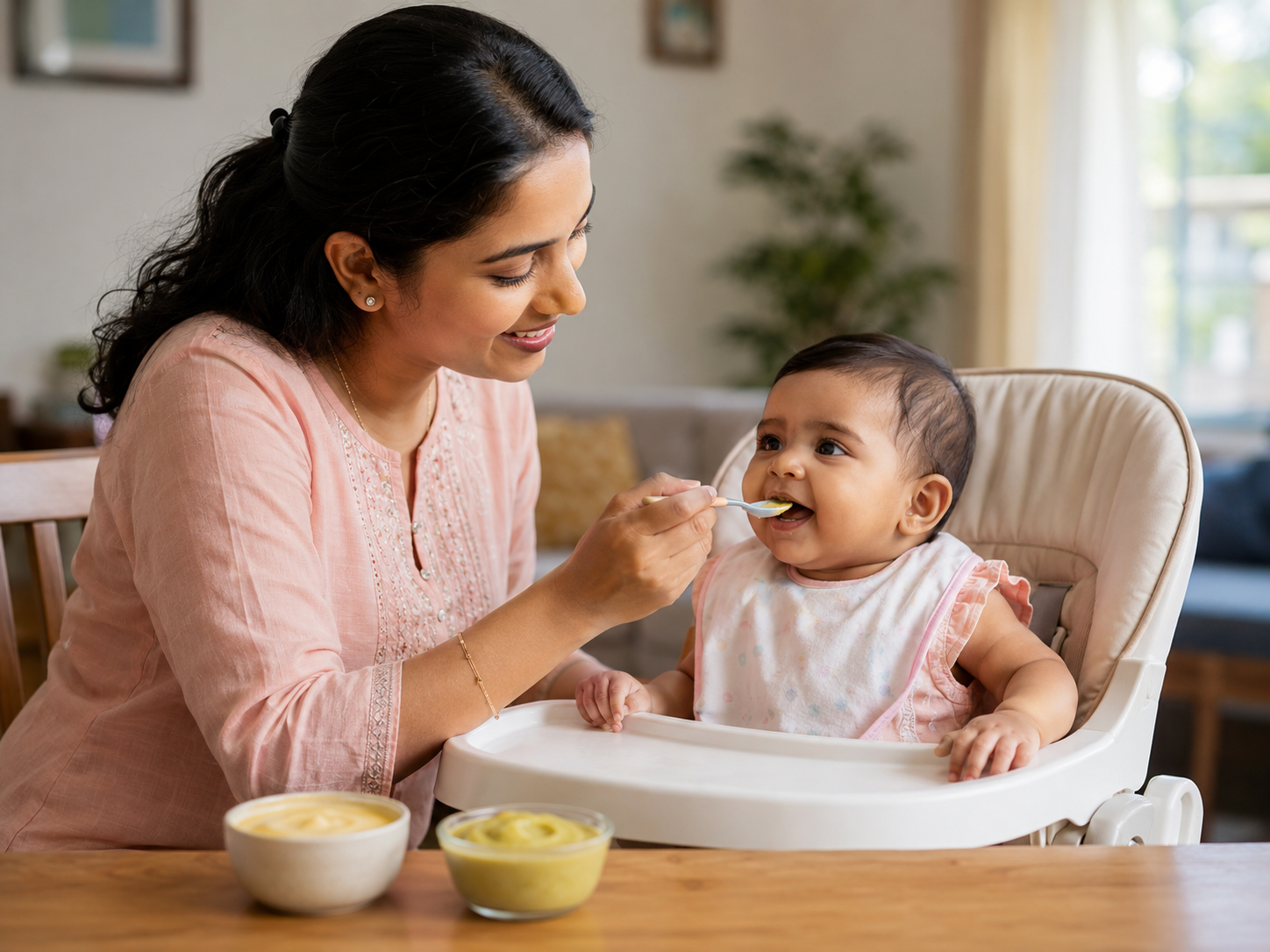
Weaning, or complementary feeding, means adding safe, age-appropriate foods after the baby completes around 6 months, while breast milk or formula continues as advised. These foods complement milk feeds because babies need extra energy, iron, and nutrients as they grow.
The foods should slowly move from soft mashed foods to thicker, lumpier, and then family-food textures as the baby develops chewing and swallowing skills.
When to start solids
- Most generally healthy babies are ready to start complementary foods around completion of 6 months.
- Readiness signs include good head control, sitting with support, interest in food, and ability to take food from a spoon.
- Do not start solids only because the baby wakes at night or seems curious before 6 months; discuss early feeding needs with your paediatrician.
- If your baby was premature, has poor growth, feeding difficulty, or a medical condition, ask the paediatrician for an individual plan.
Continue breastfeeding
- Breast milk remains important for nutrition, comfort, and immunity during the weaning period.
- Offer food calmly without replacing all milk feeds suddenly.
- Follow your clinician's advice if your baby needs formula, supplements, or a special feeding plan.
First foods and Indian food examples
Start with soft, thick, freshly prepared foods that are easy to swallow. Use familiar family foods, adapted without excess salt, sugar, chilli, or hard pieces.
- Soft dal-rice, khichdi, curd rice, idli softened with dal or curd, and well-cooked mashed rice with vegetables.
- Mashed vegetables such as pumpkin, carrot, potato, sweet potato, beans, or greens cooked until soft.
- Mashed fruits such as banana, papaya, stewed apple, pear, or chikoo when suitable and hygienically prepared.
- Protein foods such as well-cooked dal, pulses, legumes, millets, egg, fish, chicken, meat, paneer, or curd may be used according to family practice and clinician advice.
- Add a small amount of suitable oil, gingelly oil, coconut oil, or ghee to home foods when advised, especially if the food is otherwise watery or low in energy.
Quantity and frequency by age
Appetite varies, so use these as broad parent guideposts rather than a rigid target. Start small, increase gradually, and let growth review guide adjustments.
| Age | Usual approach | Parent reminder |
|---|---|---|
| Around 6 months | Begin with a few spoonfuls once or twice daily, then slowly increase as accepted. | Food should be thick and soft, not watery. |
| 7-8 months | Gradually build to regular small meals with continued milk feeds. | Offer variety across grains, pulses, vegetables, fruits, and protein foods. |
| 9-12 months | Move toward family meal timings with safe soft finger foods and thicker textures. | Encourage self-feeding practice under close supervision. |
| After 12 months | Most children can eat modified family foods with snacks as needed. | Avoid force-feeding; review growth and diet quality at clinic visits. |
Texture progression
- Start with smooth or well-mashed thick foods that stay on the spoon.
- Progress to mashed foods with soft lumps, then minced or finely chopped foods.
- Offer soft finger foods only when the baby can sit well and handle food safely.
- Avoid hard, round, slippery, or large pieces that can choke a baby.
- Gagging can happen while learning textures; choking, blue colour, breathing difficulty, or silent distress needs urgent help.
Responsive feeding and behavioural feeding principles
- Offer variety across tastes, colours, and food groups over the week.
- Repeated exposure may be needed before a baby accepts a new food; a first refusal does not always mean dislike.
- Do not pressure-feed, distract heavily, threaten, bribe, or force the mouth open.
- Watch hunger and fullness cues such as leaning forward, opening the mouth, turning away, closing the mouth, or losing interest.
- Encourage healthy family food habits because babies learn by watching parents and siblings eat.
- Persistence matters: keep offering safe foods patiently on different days, in small amounts, and in different combinations.
Foods to avoid
- Honey before 1 year of age.
- Whole nuts, hard sweets, popcorn, grapes left whole, raw carrot sticks, large apple pieces, and other choking hazards.
- Tea, coffee, sugary drinks, packaged juices, cola, and sweetened drinks.
- Excess salt, sugar, chilli, fried snacks, and ultra-processed foods.
- Maida-based foods or snacks.
- Unboiled or unsafe water, unhygienic street foods, and foods kept too long at room temperature.
- Cow's milk as the main drink before 1 year, unless specifically advised by your clinician.
Allergy and medical exclusion clauses
- Known or suspected food allergy, severe eczema, previous food reaction, or family history of severe allergy/anaphylaxis.
- Recurrent wheeze or asthma with food concerns.
- Poor growth, chronic vomiting or diarrhoea, or blood in stool.
- Prematurity, swallowing or feeding difficulty, neurological problems, or complex medical problems.
If a food causes facial swelling, breathing difficulty, repeated vomiting, lethargy, collapse, or a concerning rash, stop that food and seek urgent medical review immediately.
When to seek medical advice
- Coughing, choking, blue colour, noisy breathing, or breathing difficulty during feeds.
- Persistent vomiting, severe diarrhoea, dehydration, blood in stool, or poor weight gain.
- Refusal of most feeds, marked feeding distress, lethargy, developmental regression, or repeated gagging with textures.
- Any allergic-type reaction, especially swelling, breathing symptoms, repeated vomiting, collapse, or a widespread rash after food.
- If parents are unsure whether a food, texture, or feeding plan is safe for their baby.
Medical disclaimer
References
- Dr. Murali Gopal. Weaning Guide & Recommendation. Parent education source material.
- Indian Academy of Pediatrics parent nutrition guidance.
- ICMR-National Institute of Nutrition. Dietary Guidelines for Indians, 2024.
- World Health Organization. Complementary feeding guidance for children 6-23 months.
- HAB Eat behavioural feeding concepts used only as a reference for variety, repetition, persistence, no pressure, role modelling, and hunger/fullness cues; wording and page design are original to this portal.
Last reviewed: 27 May 2026.
© Dr. Murali Gopal | For Patient Education Only This educational material is intended for parent and patient education. Reproduction, redistribution, or modification without permission is not allowed.
Medical review and references

Scan to open the latest online version